When a second opinion helps with a major repair
Use a second opinion to resolve a diagnostic disagreement, not merely to collect a lower total for a different scope.

A second opinion is most useful when it resolves uncertainty about the diagnosis, repair scope, or responsibility for a repeat problem. Ask yourself what remains unclear before calling another shop. A lower total alone does not establish that the first recommendation was wrong, and two shops can propose different scopes for legitimate reasons. The goal is an independent explanation you can evaluate.
Possible questions include whether the findings support replacing an assembly, whether a targeted repair remains plausible, or whether the proposed supporting work addresses the cause. This site cannot answer those mechanically. Choose a qualified professional able to inspect the vehicle and explain the evidence, and agree on the scope and cost of that assessment.
Prepare a useful evidence packet
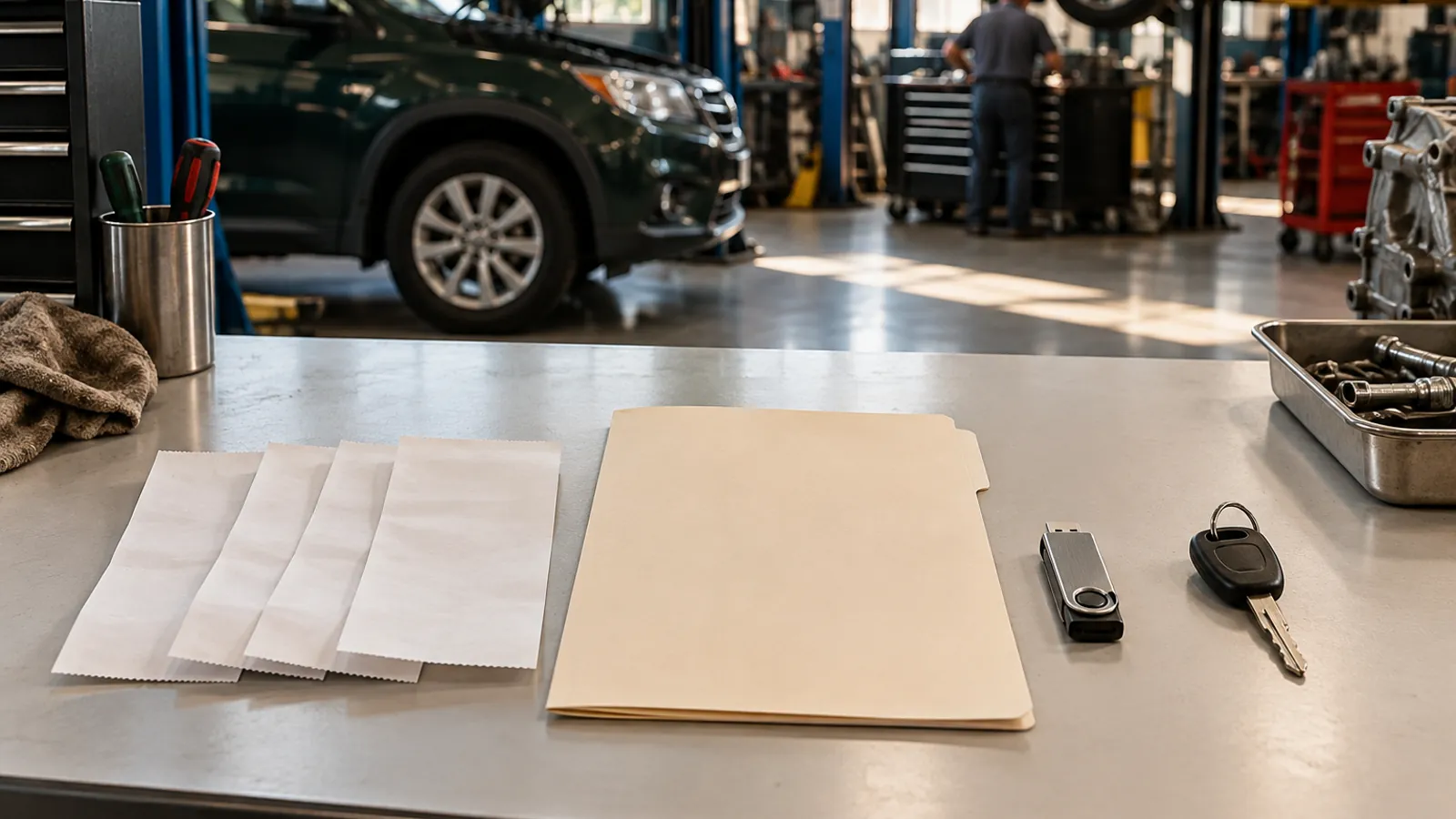
Give the second shop the same symptom history and vehicle information. Provide copies of estimates, diagnostic reports, recent repair records, and warning-message details if available. Keep originals. Ask whether it wants to inspect before reviewing the first recommendation and whether it needs to repeat tests.
- Describe when the symptom happens.
- Note what changed after any recent work.
- Bring the written scope, not just the grand total.
- Identify work already authorized or completed.
- Ask for the second opinion’s deliverable and fee.
- Clarify transport and storage arrangements.
Do not ask the second shop to guarantee a conclusion from another shop’s photographs or code list alone. A professional may need access or further tests. Ask what each stage can establish before approving it.
Account for the cost of moving
Before transferring a vehicle, ask the first shop about agreed diagnostic, teardown, reassembly, and storage charges. Ask whether the vehicle is operable and what transport is required. Then ask the receiving shop what condition it can accept and what it will charge for its own assessment.
In an illustrative scenario, moving costs $120 for transport, $200 in agreed exit charges, and $180 for a new assessment: $500 in additional decision costs. These are fictional inputs, not typical fees. That expense may or may not be worthwhile depending on the uncertainty at stake. The point is to make the transfer decision consciously rather than assume a second estimate is free once disassembly has begun.
Compare findings rather than confidence
If the recommendations conflict, ask each shop what evidence distinguishes its conclusion from the alternative. Is the disagreement about the failed component, the repairability of an assembly, the included scope, or the warranty responsibility? A confident explanation without evidence is not enough, but neither is an unsupported accusation that another business is dishonest.
Keep technical statements separate from commercial preferences. A shop may prefer to install an assembly rather than rebuild in-house, which is different from proving that no rebuild is possible. Ask whether it is describing the only technically suitable option or the service it offers. A third independent assessment may be appropriate when the disagreement remains material and the vehicle can be evaluated safely.
Use the result to choose a next step
Ask for a written summary of the second shop’s findings and proposed scope. Then decide whether to authorize further diagnosis, proceed with a repair, or investigate coverage. If you change providers, understand how the new installer’s parts and labor warranty works and whether any prior work affects it.
If you suspect unauthorized work or misleading billing, preserve records and contact the state consumer or repair agency rather than using a second opinion as a substitute for a complaint process. Legal deadlines and procedures vary. If a warranty claim is involved, contact the warrantor before authorizing outside teardown or repair that could affect the claim. An independent opinion should reduce uncertainty, not accidentally create a new coverage dispute.
Choose the opinion’s scope before the appointment
Tell the second provider whether you want an independent diagnosis, a review of a completed repair, or an installed estimate based on its own findings. These are different services. Ask what access it needs and whether it can inspect a partially disassembled vehicle before paying to move it.
If the original shop supplied photographs, ask what they can establish and what they cannot. An image may show a condition without proving its cause or the full repair needed. A useful professional explanation identifies the limits of the available evidence instead of claiming certainty from an incomplete record.
After the assessment, ask what would change the recommendation. If further teardown is necessary, request its cost and exit terms just as you would at the first shop. An independent provider should still receive a clearly bounded authorization. The second opinion is another paid decision stage, not automatic permission to complete whatever repair it ultimately recommends.
Questions before you decide
Can a phone quote be a second diagnosis?
Usually it is only a preliminary commercial estimate. Ask what inspection or testing is needed for an actual opinion.
Should I hide the first estimate?
Provide the information the second professional needs, and ask how it approaches independent testing. Do not misrepresent work already done.
What if the vehicle is apart?
Clarify reassembly, transport, receiving-shop requirements, and exit charges before moving it.
Continue with the same decision
- Repair warranties: ask what happens on the second visit
- Check recalls and manufacturer coverage before paying
- Repair estimate red flags: questions that deserve an answer
- Compare repair approaches
- Use the authorization checklist
Official sources and limits
- Federal Trade Commission — Auto Repair Basics — written estimates, repair terminology, and warranty questions.
Source links checked October 30, 2026. Dollar examples are illustrative, not surveyed prices. State-specific requirements are labeled and must be checked for the location of your repair. No licensed mechanic or attorney has reviewed this guide.